Is there something in the air? Because suddenly — and happily — lots of people are interested in Ireland’s historic women scientists.
There is a film in the making about two women from the mid-1800s: science writer Mary Ward, and early photographer Mary, Countess of Rosse. Ingenious Ireland has been helping SnugBoro Films with the story, and we were filming at lovely Dunsink Observatory yesterday (a big thank you to the Dublin Institute for Advanced Studies and Hilary O’Donnell for the hospitality).
Our campaign, if we can call it that, began 16 years ago with the publication of ‘Stars, Shells and Bluebells’, a book on the lives and legacies of a dozen historic Irish women in science from the 1600s onwards (currently out of print). We followed that with ‘Lab Coats and Lace‘ in 2009, celebrating nearly 30 more women, and taking the story up to the 20th century.
Maynooth museum celebrates one of Ireland’s greatest inventors: a great pioneer of electricity, an Irish priest who, in the 1830s, built the most powerful magnet and battery in the world, invented the induction coil (which is still used in car spark plugs) and made it into the Encyclopaedia Britannica! This is his story…
The ingenious Rev Nicholas Callan, Maynooth
A priest, a battery and a turkey
Rev Nicholas Callan (1799-1864) must have seemed like an Irish Frankenstein, experimenting with electricity in his laboratory at Maynooth College, dishing out almighty electric shocks to unsuspecting volunteers, even electrocuting turkeys.
Callan, from County Louth, was the first major Irish scientist from a Catholic background. He studied for the priesthood at the Irish College in Rome, where he learned about Alessandro Volta’s battery, a chemical device that could store electricity. Callan came home to teach science at St Patrick’s College seminary in Maynooth, and with funding from friends and family, he set about designing better batteries.
Callan’s battery was the Duracell of the day: the first truly cheap and effective battery.
The world’s biggest battery
Electricity was still something of a toy then, but Callan realised that with powerful batteries it could be put to practical use. Where existing batteries used costly platinum, Callan found a way of using cheap cast-iron: his positive plate was a small cast-iron box filled with strong acid; in it sat a porous pot, also filled with acid, and containing a zinc sheet as the negative plate.
His most successful battery design sold commercially in London as ‘the Maynooth battery’. The ‘Duracell’ of its time, it was hard-wearing and cheap, long-lasting and powerful, and Callan hoped it would be used for lighthouse lamps and remote navigational buoys, but electric lighting was still in its infancy.
Callan used to connect large numbers of these battery cells, and once joined 577 (!) together, using 30 gallons of acid. It was the world’s largest battery. Since there were no instruments to measure current then, Callan assessed his batteries by the weight they could lift when connected to an electromagnet. His best effort lifted two tons and made it into the Encyclopaedia Britannica (8th edition) as the world’s most powerful magnet. When Callan reported his results in the Annals of Electricity, a London professor came to Maynooth to witness the spectacle and was said to be ‘incredulous’.
Inventing the induction coil
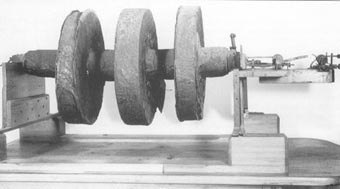
Callan's giant coil is in Maynooth Museum.
In 1836 Callan made his most important discovery – the induction coil. He wound two long wires around the end of his large electromagnet and connected the ends of one wire to a battery. But when he interrupted the current from the battery, he got a spectacular spark between the ends of the second, unconnected coil. It was the world’s first transformer.
He had induced a high-voltage in the second wire, starting with a low voltage in the first one. And the faster he interrupted the current, the bigger the spark. In 1837 he produced his giant induction machine: using a clock escapement to cut the current 20 times a second, he generated 15-inch sparks – an estimated 600,000 volts – and the largest artificial bolt of electricity then seen.
The coils were made from miles of hand-drawn metal wire which Callan laboriously insulated by hand using tape and wax. A model was sent to London for demonstrations and similar machines soon appeared in Europe and North America.
Roast turkey
The voltmeter had not been invented so to measure the voltage from his induction coils, Callan improvised. He would electrocute large birds, or shock chains of volunteers holding hands. One almighty shock rendered a future archbishop of Dublin unconscious, after which the college asked Callan to limit his experiments.
Callan’s induction coil is today used in car ignitions, for example, to generate powerful voltages from a low-voltage battery and produce sparks to cross the gap in the spark plug.
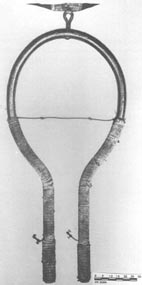
As tall as a man, Callan's magnet was made by the local blacksmith. Now on display in the museum.
In 1838 this intrepid priest stumbled on the principle of the self-exciting dynamo. Simply by moving his electromagnet in the Earth’s magnetic field he found he could produce electricity without a battery. The effect was feeble, however, so Callan never pursued it, and the discovery is generally credited to Werner Siemens in 1866.
Electric pioneer
Callan probably also had one of the world’s first electric vehicles: in 1837 he was using a primitive electric motor to drive a small trolley around his lab. With great foresight he also predicted electric lighting, at a time when oil was still widely used and gas was the next new thing.
In 1853 he patented an early form of ‘galvanisation’, using a lead-tin mix to protect iron from rusting. He even proposed using batteries instead of steam engines on the new-fangled railways. Callan later realised his batteries were not powerful enough and it took a hundred years before battery-powered trains invented by another Irishman, James Drumm, were used on Dublin railways.
Visit Maynooth Museum
The wonderful museum has all of Nicolas Callan’s inventions and instruments, and even patent documents from his inventions. It also has a lovely and extensive collection of historic scientific instruments, including some of thoseused by Marconiwhen he was pioneering commercial radio in Ireland in the late 1800s. A separate section of the museum has religious artefacts, associated with the seminary.
Opening hours: the museum is open May-September Tuesdays and Thursdays (2-4pm) and Sundays (2-6pm), and October-April by appointment. For Science Week 2012, the museum is open Saturday afternoon, November 17 2-5pm. The museum is also one of the highlights of Dublin City of Science 2012 programme.
This is a fascinating bottle with a weird story. We learned about it on a tour of historic Aungier St with Dublin City’s architects, archaeologists and conservation officers.
Witch bottle, found at Beaux (or Bow) Lane, Dublin
It’s a pottery bottle, from about 1600, intact and sealed. But x-rays reveal that there is a lot of “stuff” in it, including old nails. This leads the archaeologists to conclude that this is a “witch bottle” — a common folk magic that was used around Europe.
A bit like leaving rags at a holy tree or well, the idea was to put nails, urine, bones or other bits and pieces in a bottle, and then bury or burn the bottle. As the contents rotted, or burned, your ailments and worries would disappear. Significantly, it was also believed such a bottle could keep a curse at bay, or — better still — return a curse to the curser! And a witch bottle might be buried under a hearth or threshold.
This kind of bottle, with the face of a man, is called a Bellarmine bottle after the fierce man of the Inquisition, the Italian Cardinal Bellarmine (1542-1621).
The 'Bellarmine' face on the Dublin 'witch bottle'.
The Dublin witch bottle is currently on display (loan from the National Museum) in the hall of Beaux Lane House, along with three information panels about the area and the excavation. It is well worth a look!
The Aungier St tours continue on Wednesday and Friday of this week as part of Design Week 2012.
If you enjoy exploring hidden Dublin, you’ll find lots of useful information in the Insider’s Guide to the Dublin, compiled by people who love the city.
The historic glasshouses of the Irish National Botanic Gardens
Find out on this audio guided tour of the Botanic Gardens in Glasnevin — the ‘alphabet tree’ is just one of the many fascinating stories featured on our Red tour of the historic gardens.
Other stories include the unusual ‘pulsation engine’ and how it pumped the old mill stream in the gardens uphill to the glasshouses. You’ll also discover why Chinese roses were so much more interesting than European ones and what the gardens are doing to monitor climate change.
Along the way you can sit a while in the chain tent that is part metal and part tree and if you’re lucky you might catch the blue green flash of a kingfisher down by the river. Visit in May and you can enjoy one of the garden’s delights, the Chinese handkerchief tree in full bloom.
Self guided tour of the Glasnevin Gardens
Allow about an hour for the tour. This podcast is an ideal guide to exploring the gardens or perfect for an armchair tour that will transport you to the historic and beautiful gardens. Ideal for anyone interested in the role science and botany have played in Irish history. Click to download the podcast tour here.
A full crop of Handkerchiefs
The visitor centre in the garden has a cafe and occasional exhibitions, and ample car and bike parking.
The podcast is available to download from our Ingenious Ireland websiteand you can keep up with all our latest podcasts by subscribing to our iTunes channel.
The Botanic Gardens Ingenious Ireland Podcast tour: Yellow
Addison's 300-year-old walk
Do you want to know who lives in one of the fanciest houses in Glasnevin? And hear how early botanical gardens were the pharmacy shops of their day?
Come on this audio guided tour and we will bring on a fascinating walk around Ireland’s National Botanic Gardens in Dublin, including a stroll down a tree-lined avenue that is over 300 years old.
You’ll hear stories like that of the father and son who helped to discover potato blight, how Thomas Moore’s ‘last rose of Summer’ has Chinese ancestry and how it brightens even the darkest winter days. Stories like these and many more await in this Ingenious Ireland audio guide podcast.
Self guided tour of the Glasnevin gardens
Allow about an hour for the full tour. This podcast is an ideal guide to exploring the gardens, or perfect for an armchair tour that will transport you to the historic and beautiful surroundings of the Botanic Gardens, Glasnevin. Ideal for anyone interested in the role that science and botany have played in Irish history. Click to download the podcast tour here. The visitor centre in the gardens has a cafe, and there is ample parking for bikes and cars.
This is the second in a series of three audio tours made in association with National Botanic Gardens, and with grant aid from the Department of Tourism, Culture and Sport under the Cultural Technology Grant Scheme.
Augustine Henry: plant hunter extraordinary
The podcast is available to download from our websiteand you can keep up with all our latest podcasts by subscribing to our iTunes channel.
Tuesday October 16th 2102: on Hamilton Day, the day quaternions were invented in Dublin in 1843
As hundreds of geeks gather in Dublin for the WebSummit… two new city walking tours are launched to celebrate Ireland’s many great inventions and scientific discoveries.
Plaque marking the Dublin house where starlight was measured for the very first time.
Did you know. . . that Dublin algebra helped to land a man on the Moon?! That an Irish physicist shared the Nobel Prize for splitting the atom? That perforated stamps were invented by a Dublin printer? And that he made a fortune just from punching holes in paper? Or that the first ever hypodermic injection was performed at the city’s Meath Hospital?
These are just some of the many Irish inventions and discoveries featured in two new Dublin walking tours that celebrate home grown ingenuity, and are launched today. The launch marks Hamilton Day, the anniversary of the day in 1843 when Ireland’s greatest scientist, Sir William Rowan Hamilton, invented a revolutionary new type of algebra, called quaternions, by the Royal Canal at Cabra. Quaternions are now used to control spacecraft, and in computer animations.
The new ‘ingenious Dublin’ tours are doubly unusual and innovative: they tell stories of invention and innovation, and they are digital tours – ‘audio guides’ (MP3) that visitors can download. The tours are written and narrated by an award-winning writer and broadcaster, and mean people can enjoy a perfect tour whenever they want – even listen to the stories at home or on the bus.
Two new tours
The new tours are:
Ingenious Inventions – discover Irish inventions, from major ones that changed the world, such as the steam turbine, to smaller ones such as Sudocrem and even the ISBN.
Elephants and Earthquakes – meet the ingenious Irish scientists whose discoveries and ideas changed the world, including the man who founded the modern science of seismology when he blew up Killiney beach, and the definitive anatomical account of an elephant!
Mary Mulvihill, the science writer who developed the tours, said that “Ireland is great at celebrating our writers and artists, but we also produced lots of great inventors, scientists and engineers, and I’d love more people to know these stories, and be proud of them.”
Her new tours are already something of a cult hit. “We developed these as walking tours over the summer, and now we’re being asked for them by all kinds of groups, even transition year classes, and an alternative hen party!”
The tours will appeal to a wide audience. “They are kind of geeky, yet our biggest audience for our stories is ordinary Dubliners of all ages – they just love learning something new about their home town. And at the end, everyone always says: That was really interesting, I never knew that about Dublin!”
Explaining why the tours have been launched as audio guides, Mulvihill said that this approach is increasingly popular for walking tours internationally. “You get your very own tour, with an expert guide, to take at your own pace, so it’s really convenient, and all for less than the price of a coffee.” The innovative yet simple solution means her company can provide guided tours all year, 24/7.
The new tours cost just €1.99 and are available to download here. And, because milk chocolate was invented by an Irish doctor, the tours come with a Butler’s Chocolates 10% discount!
An important statistical technique was invented at Guinness’s Dublin brewery, as part of quality control in 1908. By helping to improve the product, it helped to make Guinness an international brand. An extract from our new book, Ingenious Dublin, for Arthur’s Day 2012.
William Sealy Gosset, who invented the Student 't' test at Guinness's Brewery in Dublin
If you wanted to know the average height of the Irish population you could get a reasonably good estimate by measuring a random sample of 1,000 people. But how good would your estimate be if you could measure only 10 people?
In 1900, brewers at Guinness’s faced just this kind of problem: they were testing new barley varieties that had been grown in trials by the Department of Agriculture, but many of the trials were small and could not easily be repeated – for instance, it would take another year to grow more grain, and the weather then would be different.
Trying to evaluate some of the varieties was like trying to measure the Irish population by studying 10 people. Fortunately, Guinness’s had just recruited a new brewer, a mathematically minded Englishman William Sealy Gosset(1873–1937), who devised a statistical way of evaluating the results produced from small samples.
Guinness staff could not publish under their own name then, because of a previous case when a staff member published trade secrets. So Gosset published his technique in an international journal under the pseudonym ‘Student’. His paper was called: ‘The probable error of a mean’. His technique, called Student’s t-test, is still widely used by statisticians.
By helping to improve the quality of the barley and the brew, Gosset’s test helped to establish Guinness as a reliable, quality brand. And the rest is history.
Where in Dublin can you peer inside a Victorian diving bell? Or see the skeleton of Tommy, the prince’s elephant? Where was the world’s first earthquake experiment done? Did you know the hypodermic syringe was invented in the former Meath Hospital? And that Dublin algebra helped to land a man on the Moon?!
Discover the answers* to these questions and many more in Ingenious Dublin, a new guide to the city and county packed with fascinating and quirky stories from Dublin’s long history.
Written by award-winning science heritage writer Mary Mulvihill, the book looks beyond the usual views of Dublin, to explore the very fabric of the city, and how it was built, and tell of the many great ingenious people who lived and worked here, and whose discoveries and inventions helped to change the world.
The book is richly illustrated, and packed with stories and recommendations of places to visit, all organised by location. It’s a perfect book for Dubliners and tourists alike, and for families and teachers planning outings, from Poolbeg lighthouse and the Great Wall of Dublin, to Dunsink observatory and Skerries mills. It would be a great source for quirky pub-quiz questions, and is being dubbed “the ultimate geek’s guide to Dublin”!
Explaining why she wrote the book, Mary Mulvihill said: “We are great at celebrating our Irish writers and artists, but we also produced lots of great thinkers. Many well known and important inventions and discoveries were made here too, by scientists and engineers, and I’d love more people to know these stories, and be proud of them.
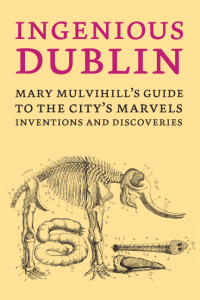
“For instance, the skeleton of the elephant featured on the cover comes from an amazing dissection that was done in Temple Bar in 1681 and is world famous – an English theatre company is even talking about recreating the event in Essex Street next year!”
The new guidebook is an e-book, making it easy to carry round the city on a smartphone or iPad. It can be read on any device, thanks to free Kindle software and apps, and it comes with a complimentary e-book of 10 detailed maps.
*Answers to questions: The Victorian diving bell is on Sir John Rogerson’s Quay. The Skeleton of Tommy can be found in the Zoology museum in Trinity College Dublin. The worlds first earthquake experiment was done on Killiney beach and Quarternion algebra invented in Cabra helped put a man on the moon.
Want to know what links Ludwig Wittgenstein and the celery-topped pine tree?
Then come with us on our podcast tour of the wonderful glasshouses in the Irish Botanic Gardens at Glasnevin, Dublin. You’ll hear stories about weird plants, the engineering of a glasshouse, exotic orchids, and some of the science and scientists associated with the gardens. Click to download the podcast tour here.
Turner's ingenious glasshouses
This audio tour will take you inside the world famous glasshouses, architectural treasures that Richard Turner designed in the 1840s. We’ll introduce you to some of their most fascinating residents, including the loneliest tree in the world, the Wood’s Cycad.
We will have you imagining the smell from all the aromatic plants, and introduce you to a fearsome plant, known as the Queen of the Andes, that eats birds and sheep.
This 40 minute podcast tour is an ideal guide to your visit to the gardens, or perfect for an armchair tour that will transport you to the steamy surroundings of the tropical glasshouses in the Botanic Gardens, Glasnevin. So if you are interested in the role that science and botany have played in Irish history, this series of podcasts is just right for you. Click to download the podcast tour here.
Bananas growing in Dublin's Botanic Gardens
This is the first in a series of three audio tours from the gardens made in association with National Botanic Gardens and with grant aid from the department of Tourism, Culture and Sport under the Cultural Technology Grant Scheme 2010.
For more about the fascinating history of science in Ireland, visit our website.
Do you enjoy a song, a walk and a good algebra equation?
Ireland's greatest scientist, Sir William Rowan Hamilton
Then you’ll enjoy our podcast walking tour. It features a lovely stroll by Dublin’s Royal Canal, tracing the steps of Ireland’s greatest scientist Sir William Rowan Hamilton, on the day he invented a new type of algebra. Click to download the podcast here.
Hamilton’s algebra is called Quaternions, and you could say that it helped to land a man on the Moon because, among other things, it’s used to control spacecraft, and was vital to Nasa’s Apollo missions.
Every year, on Hamilton day (October 16th) hundreds of people join the annual commemoration walk from Dunsink Observatory to Broome Bridge, the very spot where Hamilton invented his new form of mathematics in a flash of inspiration. It’s a key moment in the history of Irish science.
Quaternion equation at Broome Bridge by the Royal Canal
Our podcast was recorded on the 2011 walk, and features the ballad of William Rowan Hamilton (written by local man Jack Gannon), lots of stories and information about the Royal Canal, its engineering, wildlife, and even how canal locks work, plus interviews with many of the people who attended.
You can use the podcast to take your own tour along the canal towpath. The audio lasts 44 minutes, and the route by the canal is about 4 km long, and wheelchair accessible.
So if you fancy a stroll, or even listening from the comfort of your couch, have a listen and learn about one of Ireland’s most important scientists.
The podcast is presented by science journalist Mary Mulvihill, from Ingenious Ireland, and the production was supported by Maths Week Ireland and IRCSET. Full details, the route, and getting to and from the canal are here.
Promoting Ireland’s rich scientific heritage.
This is the first in a series of Podcast tours — more to follow soon.
 There is a film in the making about two women from the mid-1800s: science writer Mary Ward, and early photographer Mary, Countess of Rosse. Ingenious Ireland has been helping SnugBoro Films with the story, and we were filming at lovely Dunsink Observatory yesterday (a big thank you to the Dublin Institute for Advanced Studies and Hilary O’Donnell for the hospitality).
 on the lives and legacies of a dozen historic Irish women in science from the 1600s onwards (currently out of print). We followed that with ‘Lab Coats and Lace‘ in 2009, celebrating nearly 30 more women, and taking the story up to the 20th century.


 Callan’s battery was the Duracell of the day: the first truly cheap and effective battery.