Tag: Ingenious Dublin

  • How statistics helped to make Guinness good!

    An important statistical technique was invented at Guinness’s Dublin brewery, as part of quality control in 1908.  By helping to improve the product, it helped to make Guinness an international brand.  An extract from our new book, Ingenious Dublin, for Arthur’s Day 2012.

    William Sealy Gosset, who invented the Student 't' test at Guinness's Brewery in Dublin

    If you wanted to know the average height of the Irish population you could get a reasonably good estimate by measuring a random sample of 1,000 people.  But how good would your estimate be if you could measure only 10 people?

    In 1900, brewers at Guinness’s faced just this kind of problem: they were testing new barley varieties that had been grown in trials by the Department of Agriculture, but many of the trials were small and could not easily be repeated – for instance, it would take another year to grow more grain, and the weather then would be different.

    Trying to evaluate some of the varieties was like trying to measure the Irish population by studying 10 people.  Fortunately, Guinness’s had just recruited a new brewer, a mathematically minded Englishman William Sealy Gosset (1873–1937), who devised a statistical way of evaluating the results produced from small samples.

    Guinness staff could not publish under their own name then, because of a previous case when a staff member published trade secrets.  So Gosset published his technique in an international journal under the pseudonym ‘Student’.  His paper was called: ‘The probable error of a mean’. His technique, called Student’s t-test, is still widely used by statisticians.

    By helping to improve the quality of the barley and the brew, Gosset’s test helped to establish Guinness as a reliable, quality brand.  And the rest is history.

    Discover lots more stories like this, in in our new e-book:  ‘Ingenious Dublin: Mary Mulvihill’s guide to the city’s marvels, inventions and discoveries’. Downloaded the first chapter for free, and discover all about the River Liffey, the geology of Dublin Bay, and the engineering and development of Dublin docks.
  • New book celebrates Dublin inventions, discoveries and hidden stories


    Think you know Dublin?

    Press release: August 27th 2012

    Where in Dublin can you peer inside a Victorian diving bell? Or see the skeleton of Tommy, the prince’s elephant? Where was the world’s first earthquake experiment done? Did you know the hypodermic syringe was invented in the former Meath Hospital? And that Dublin algebra helped to land a man on the Moon?!

    Discover the answers* to these questions and many more in Ingenious Dublin, a new guide to the city and county packed with fascinating and quirky stories from Dublin’s long history.

    Written by award-winning science heritage writer Mary Mulvihill, the book looks beyond the usual views of Dublin, to explore the very fabric of the city, and how it was built, and tell of the many great ingenious people who lived and worked here, and whose discoveries and inventions helped to change the world.

    The book is richly illustrated, and packed with stories and recommendations of places to visit, all organised by location.  It’s a perfect book for Dubliners and tourists alike, and for families and teachers planning outings, from Poolbeg lighthouse and the Great Wall of Dublin, to Dunsink observatory and Skerries mills.  It would be a great source for quirky pub-quiz questions, and is being dubbed “the ultimate geek’s guide to Dublin”!

    Explaining why she wrote the book,  Mary Mulvihill said: “We are great at celebrating our Irish writers and artists, but we also produced lots of great thinkers.   Many well known and important inventions and discoveries were made here too, by scientists and engineers, and I’d love more people to know these stories, and be proud of them.

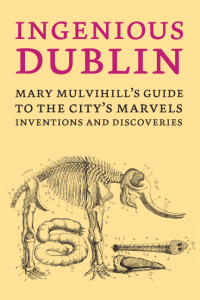
    “For instance, the skeleton of the elephant featured on the cover comes from an amazing dissection that was done in Temple Bar in 1681 and is world famous – an English theatre company is even talking about recreating the event in Essex Street next year!”

    The new guidebook is an e-book, making it easy to carry round the city on a smartphone or iPad.  It can be read on any device, thanks to free Kindle software and apps, and it comes with a complimentary e-book of 10 detailed maps.

    Ingenious Dublin is selling at a special launch price of just €0.99 (cover price €3.99) until September 15th.

    *Answers to questions: The Victorian diving bell is on Sir John Rogerson’s Quay. The Skeleton of Tommy can be found in the Zoology museum in Trinity College Dublin. The worlds first earthquake experiment was done on Killiney beach and Quarternion algebra invented in Cabra helped put a man on the moon.


Privacy Overview
Ingenious Ireland

This website uses cookies so that we can provide you with the best user experience possible. Cookie information is stored in your browser and performs functions such as recognising you when you return to our website and helping our team to understand which sections of the website you find most interesting and useful.

Strictly Necessary Cookies

We use these cookies to make our website work including:

- Making our shopping basket and checkout work
- Determining if you are logged in or not
- Allowing you to add comments to our site

If you really want to turn off these cookies you can usually switch cookies off by adjusting your browser settings - find out how here. Please note: the website might not function as well without these cookies.