TCD student has won the 2018 Mary Mulvihill Award:
DUBLIN, 23 May 2018—Trinity College Dublin (TCD) environmental science student Katie Carbonara is the 2018 winner of the Mary Mulvihill Award, the science media competition for third level students that commemorates the legacy of science journalist and author Mary Mulvihill (1959–2015).
One of Ireland’s most respected living scientists Dame Jocelyn Bell Burnell presented the award to Katie Carbonara, which includes a cash prize of €2,000.
Dame Jocelyn Bell Burnell and Award recipient Katie Carbonara
This year’s competition invited entries on the theme ‘Science: Whose facts? Whose truth?’. Carbonara’s winning entry explores why “blatant scientific illiteracy” is so rampant at a time of extraordinary scientific achievement. The reductionist nature of scientific inquiry may have contributed to this paradox, she suggests.
By divorcing fact from value, science has allowed itself to become beholden to the whims of political will, funding, publications, and number of citations: a contest for the most charismatic ideas and results,” she writes. “At the same time, a dichotomy exists between the idolization of science as a panacea for all the world’s ills and the deliberate attack on truths that are widely acknowledged within the scientific community”.
Siobhán Grayson, Katie Carbonara and Abeba Birhane (2018 Award Recipients) with Jocelyn Bell Burnell.
Abeba Birhane and Siobhán Grayson were awarded runners up. The PhD students in cognitive science and computer science at University College Dublin (UCD) submitted a joint entry which analyses the assumptions that allow algorithms to pervade our social sphere unchecked.
Data science, like other sciences, is a human endeavour and prone to human biases,” they argue. “Truth in data science is far from fixed, objective and independent of the values and interests of the data scientist herself.”
This is the second year of the Mary Mulvihill Award, set up to honour Mary’s memory and the legacy of her work. “It’s a poignant time for her family and close friends; but it’s also a proud moment, as the award allows us to continue, in a small way, Mary’s role as an educator, mentor and advocate of science,” says Anne Mulvihill, a sister of Mary, and a member of the judging panel. “This year’s winner, Katie Carbonara, has written a very accessible piece on a complex topic, questioning the discipline of science and the work that it does; Mary would have approved,” she said.
The award worth €2000 was won by an MSc student in world heritage conservation at University College Dublin, Irene Fogarty – who also works as an audience researcher with The Irish Times – for her essay Indigenous Women and Science Knowledge. Irene has very generously offered to donate half of her prize to UN Fund for Gender Equality, in Mary’s memory.
Anne Burke, Jane Grimson, Adeleh Mohammadi & Irene Fogarty (2017 Award Recipient)
The world’s first guided missile was invented in the 1870s by an ingenious Irish man, Louis Brennan. Brennan also invented what is probably the first tilting train and an early type of helicopter.
Brennan’s guided missile was a torpedo steered by wires. It was designed to defend naval ports and harbours – not as an attacking weapon – and the British Navy paid Brennan handsomely for his idea, installing his torpedo system around the empire, from Hong Kong to Malta to Cork.
For nearly 30 years, it was the best way to defend a port, yet it was never “fired in anger” and, so far as we know, never killed anyone – which must be unusual for a weapon that was considered to be very successful.
Louis Brennan (1852-1932) was born in Castlebar, Co Mayo, but his family emigrated to Melbourne, Australia when he was about nine. He was a natural mechanic and talented engineer who started work in a clockmakers, and by his 20s was working for a well-known Australian engineering firm. He had already invented a mincing machine and a window safety catch before he had his ‘lightbulb’ idea for a torpedo that could be steered.
According to one account, he was playing with a reel of thread and noticed that, when he pulled the thread, the reel moved forward. That got him thinking about things that move need to move forward but don’t need to come back, and the rest is military history.
Guided missile
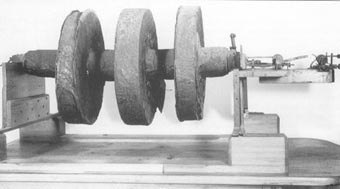
Replica of a Brennan torpedo
His guided missile was a torpedo with two long reels of wire in its ‘belly’, one left, and one right, that could be used to steer the torpedo, like the reins on a horse. The torpedo was fired from a launching station on shore, and the gunner could steer the torpedo to its target, up to 3 miles away.
You can still see the launching rails on a slipway at Fort Camden near Crosshaven, in Cork, where the system was installed.
The torpedo travelled just under the surface, with a little flag showing above the water, so that its movements could be tracked. The British Navy paid Brennan handsomely for his invention, and brought him to England to set up and run a factory making his ‘Brennan torpedoes’.
Now successful and wealthy, Brennan switched his energies to revolutionising train design. He invented a new monorail design that he hoped would be better, cheaper and quicker to build, because it needed just a single rail, instead of the traditional two rails.
First tilting train?
Brennan’s gyro-car, on a test-drive
His train ran on a central ‘wheel’, and used gyroscopes to keep it balanced. It could tilt, and easily handled tight corners and steep climbs. Brennan thought it would be perfect in remote and difficult terrain, such as the Burmese jungle and the mountainous Himalayas, where the British Empire was expanding.
He successfully demonstrated the design, but the authorities worried that the train would topple if one of the gyroscopes failed. Brennan couldn’t persuade them, and the project failed. But Brennan had poured all his resources into the project and was now broke, so he returned to work as a military consultant during World War I.
Test flights took place in a heavily guarded hangar, and the unusual craft successfully rose a few feet in test flights, albeit still tied down, and even carried a couple of men. Unfortunately, it failed during one demonstration and once again the military decided not to proceed, and switched to alternative designs.
Louis Brennan, one of the ingenious Irish, was hit by a car while on holiday in Switzerland, and died shortly afterwards of his injuries, aged 79.
He was buried in an unmarked plot at St Mary’s Roman Cemetery, Kensal Green, London. A gravestone was finally erected in 2014 by one of his county-men, Taoiseach (Irish prime minister) Enda Kenny.
The huge success of last month’s Dublin Web Summithelped to focus attention on how few women were participating – less than 10%, and many of those were moderators and not speakers.
Trouble is, there’s nothing new about this. The lack of women speakers at the Web Summit was also commented on in 2012, and 2011. In fact, little has changed in terms of women’s participation in science, technology and engineering in a whole generation.
It’s nearly a quarter-century since I called friends and colleagues together to set up the Women in Technology & Science (WITS) network, just as Mary Robinson was elected our first woman president. Heady days. Yet, a generation later, we still have relatively few women in senior positions in academia and industry, and on state boards in science and technology.
The pace of change is truly glacial. So, if we want to see meaningful change, then clearly we need to intervene with a range of initiatives, before society misses out on yet another generation of women’s talent.
Web Summit founder Paddy Cosgrave is someone who likes to make an impact, judging by his many projects – so what better impact, for his 2014 Summit, than to aim for at least 25% women speakers? And to hit an equitable 40% by, say, 2017? The Dublin summit has the scope and scale to be an agent of change, and make a real difference.
And so here are a few suggestions on how to achieve those targets . . .
Elsewhere, Mullaly has written about why most casting directors are women. So perhaps there is a good reason to send some women in Hickey’s place instead — Mullaly herself, perhaps, along with other experienced women tech writers such as Karlin Lillingtonwould make excellent talent scouts.
Mentoring and role models
Ask all of this year’s women speakers to send, or bring with them, another woman speaker for next year. Many women are shy about putting themselves forward, but may be more likely to participate if they are being encouraged and minded by a role model who has ‘been there, done that’.
Many potential women speakers presumably also think the Summit is not for them. Yet the popularity of talks such as the history of computingby Leonard Kleinrock, show that there is potential for a wide range of topics.
Ban the ‘booth babes’
We shouldn’t even have to suggest this. Since when did Top Ten Tips for Tech Success include hiring some booth babes? If your business is worth bringing to the Summit, then it should not need to sell women’s bodies to attract attention. Get back to the drawing board guys, and lose the babes. Figure out what’s great about your business idea, and pitch that. You’ll end up with a better pitch, and maybe even a better business idea. Your investors and customers will thank you. So will your mothers and sisters, your girlfriends and wives, and your daughters. Let’s have some respect.
So, in summary
Dear 30-year-old me*. . . The good news, is that WITS will go on to achieve many successes. In 2013, 10,000 people will descend on Dublin for a techie conference. And a few weeks later, seven (yes, seven!) women’s organisations will gather for a sell-out “women in tech” eventlater this week, under the hashtag #WeAreHere. The bad news is that there is still lots to do. But with the current focus on the issue, here’s hoping big change is on the way.
Mary Mulvihill is a science writer and editor and her company, Ingenious Ireland, develops geeky tours of Dublin. She was the founding chairperson of WITS in 1990, and she has edited two books on the lives and legacies of historic Irish women scientists and pioneers. Before all that, she was a research geneticist and statistician, but that’s another story.
Dublin is famous for her writers and Riverdance, but the city also has a rich geeky past. Here are 10 highlights and secret Dublin treasures, from amazing fossils to a pioneering diving bell, and even an equation that landed a man on the Moon. And they are all free!
1. Do the world’s geekiest walk
Geeks gather at Broombridge plaque
Geeks come from all over to pay homage at the place where a revolutionary new algebra was invented in 1843. The equation — called quaternions — is now used to run 3-D animations and control satellites, and it even put a man on the Moon. A plaque on the canal bridge marks the spot where William Rowan Hamilton had his Eureka moment. From there you can walk in his footsteps along the towpath. The start is a little desolate, but it soon improves, and it’s a pleasant 30 minutes stroll by the canal to Ashtown cafe, where you get the train back to town. Where: Broome Bridge, Royal Canal. More info: our free Eureka podcast tour.
2. Pay homage to some great geeks
FitzGerald plaque Ely Place
The scientist who built the first particle accelerator, and split the atom. The physicist who first proposed radio waves.. And the father of quantum mechanics… just some of the great scientists who lived and worked in Dublin, and are honoured with a commemorative plaque. Nobel physicist and atom splitter Ernest Walton is at TCD physics department; quantum mechanic Erwin Schrodinger is at 64 Merrion Square; and the great ideas man, George Francis Fitzgerald is at 7 Ely Place.
3. See the engine that electrified the world
Parsons steam turbine
You are reading this blog thanks to the steam turbine, a revolutionary new device that made efficient and widespread electricity generation possible and, later, the jet engine. The steam turbine, invented in 1884 by Charles Parsons, who was from Birr Castle in Co Offaly, is still used in power plants today. Visit: see Parson’s working scale model, in TCD’s Parsons engineering building, Mon-Fri 9-5.
4. Explore an historic diving bell
The world’s biggest diving bell, in 1866
Most people ignore the big rust-red metal box resting on the quay walls. Yet this is an historic diving bell — and possibly the biggest of its kind when it was built in 1866. Crews of 5 men worked inside, levelling the river bed, to lay foundations for quay walls when Dublin’s new deep-water port was being created. The work used what were then the world’s biggest concrete blocks! The bell was used for nearly 100 years and you can now see inside, thanks to a couple of port-holes. Where: Sir John Rogerson’s Quay.
5. Walk the Great Wall of Dublin
Walk the Great South Wall
While you’re on the quays . . . Grab a Dublin Bike and make for Dublin’s great south wall. Then take a bracing walk along the top of this great feat of engineering, out into the sea, for a breath of fresh air and some amazing views. Stretching from the city centre to the lighthouse at its tip, this is arguably Europe’s longest sea wall, some 7km long. And yes, it is visible from space! Where: South Bull Wall, Poolbeg.
The first legal ruling on Copyright was made by the Irish high king in AD 561, when he ruled ‘To every cow its calf, to every book its copy’. The dispute was over a manuscript copy of some psalms… and amazingly, that manuscript survives. It is in the wonderful Royal Irish Academy library, where it is often on display — if another manuscript is on show when you visit, you can still pick up a postcard of the Cathach (pictured). The Academy is a hidden Dublin treasure, well worth visiting. Where: RIA, Dawson Street. More info: our free RIA audio guide.
7. See some of the world’s oldest fossil footprints
In the delightful Dead Zoo
Fossil tracks that are 385 million years old, from Co Kerry, are among the treasures in Dublin’s Natural History Museum. This quaint Victorian museum, known locally as the Dead Zoo, is also a delight – a museum piece itself, largely untouched for over 100 years, it is full of creatures that have been chopped, pickled and stuffed. For children of all ages! Where: Natural History Museum, Merrion Street.
8. Use a Victorian telescope
Dunsink’s historic telescope
Book yourself free tickets for one of the open nights at historic Dunsink Observatory. The astronomers will roll back the dome and swing the telescope into position so you can see the heavens above (at least, if the skies are clear!). Founded in 1785, the observatory is Ireland’s oldest scientific institution, and still in use. Where: Dunsink Observatory. Book your tickets here.
9. The Irish Frankenstein’s laboratory
The induction coil. Invented at Maynooth!
Ok, he didn’t experiment with human bodies but, in the 1830s, a priest-professor at St Patrick’s College in Maynooth did experiment with electricity and along the way invented the induction coil. Rev Nicholas Callan also built the world’s most powerful battery and most powerful electromagnet, and even had an early electric vehicle – well, a battery-powered trolley that he drove around his lab! That lab and his inventions are all on display in the college museum, along with lots of other wonderful scientific paraphernalia. Where: St Patrick’s College museum, Maynooth. May-Sept Tues, Thurs & Sun afternoons; Oct-April by appointment.
10. The geek’s guide to Dublin
Dublin’s streets are so full of geeky stories, that we’ve made a whole ebook about them! It’s Ingenious Dublin: a guide to the city’s marvels, inventions and discoveries, and the first chapter is free — it introduces the city, and explores the River Liffey, the ‘bay area’, and the historic port, with stories such as the diving bell and the great south wall. The book is richly illustrated, with hundreds of stories across the city and county, and lots of suggestions of places to visit and things to see. You don’t need a Kindle to read it — just download the free Kindle software to any device. And if all that’s not enough, you can take one of our ingenious Dublin guided tours. Thanks to technology, you can enjoy the tours any time you want — even from the comfort of your own armchair! Just download the audio or the app tour to your player, and away you go. There are lots to choose from, many of them are free, and they’re oh-so convenient!
Dublin’s newest walking tour has an air raid shelter, elephants, earthquakes and chocolate!
On an air raid shelter deep in Dublin, are the geeky guides for Dublin’s newest and most unusual walking tour: Ronan Lyne (left), director Mary Mulvihill, with the Irish equation that helped to land a man on the Moon, and Patrick Roycroft. Photo: Barry Cronin
Not so much Men in Black . . . as Men in White Coats! Dublin’s quirkiest new walking tour celebrates great Irish inventions and ideas, and it’s surely the only tour in the world that combines an air raid shelter with chocolate.
Starting at Science Gallery every morning, the 90-minute odyssey boasts several surprising stories, including that air raid shelter (hidden deep in a quiet corner of the city), two elephants, some earthquakes, postage stamps and a delicious Butler’s chocolate, and even the engine that electrified the modern world.
‘Big ideas’ tour
There are some big ideas in the Ingenious Dublin tour — like, the Irish equation that helped to land a man on the Moon — as well as little inventions like the stethoscope, which changed our everyday lives… All with an Irish connection, and all to be found on the city streets.
The new daily tour is the brainchild of science writer Mary Mulvihill, who admits she is “… on a bit of a mission! I’d love more people to knew that some of the great ideas that have shaped the world came from Ireland and Irish people, and that these are things we can be proud of.”
Her company, Ingenious Ireland, has a range of tours, family trails, apps and downloads, all with a geeky twist. Alongside the new ‘big ideas’ tour, these include a ‘Blood and Guts’ tour of horrible histories, and Dublin Rocks, a geology and fossil tour (both from Christ Church Cathedral on Sundays at noon).
Is there something in the air? Because suddenly — and happily — lots of people are interested in Ireland’s historic women scientists.
There is a film in the making about two women from the mid-1800s: science writer Mary Ward, and early photographer Mary, Countess of Rosse. Ingenious Ireland has been helping SnugBoro Films with the story, and we were filming at lovely Dunsink Observatory yesterday (a big thank you to the Dublin Institute for Advanced Studies and Hilary O’Donnell for the hospitality).
Our campaign, if we can call it that, began 16 years ago with the publication of ‘Stars, Shells and Bluebells’, a book on the lives and legacies of a dozen historic Irish women in science from the 1600s onwards (currently out of print). We followed that with ‘Lab Coats and Lace‘ in 2009, celebrating nearly 30 more women, and taking the story up to the 20th century.
The Sage of Science, biography of JD Bernal by Andrew Brown
Watson and Crick would never have discovered the DNA double helix in 1953, if it hadn’t been for an ingenious Irish scientist, who was born on this day 1901. That scientist was the great JD Bernal, who pioneered the study of the structure of proteins and other complex molecules, and is regarded by many as the father of modern biomolecular studies.
Jim Watson, in Dublin recently to mark the 60th anniversary of the discovery of the double helix, acknowledged his debt to Bernal in a talk at the Royal Irish Academy:
“I think it is true that without the Irish connection I wouldn’t be here. When you think about it some discoveries are inevitable… The three-dimensional structure of DNA was going to be found sometime between 1952 and 1955, it couldn’t have gone on any longer.
“But J.D. Bernal might not have ever existed! And I’m not sure that anyone else would have ever found all the space groups, and taken pictures of proteins. So one could imagine protein crystallography not starting for another 20 years, 30 years. So that was not at all inevitable, it was sort of accidental.”
Brilliant Bernal
Bernal was a brilliant, colourful and controversial man, and one of Ireland’s greatest and most fascinating scientists — definitely worth reading about.
He was born on this day May 10 in 1901, in Co Tipperary.
The opening of Dalkey atmospheric railway in 1844, Illustrated London News
A most unusual train connected Dun Laoghaire and Dalkey for 10 years, until the last journey took place on this day 1854, and the railway closed. It was the end of an era, and an unusual experiment in railway design. But you can still follow the route of the train, and still see the Atmospheric Road street sign at Dalkey.
Where most trains had an engine to pull the train, Dalkey’s ‘atmospheric’ train had no engine, and instead, the train was essentially “sucked” up the hill by a steam engine located beside the track. This alternative arrangement called for a complicated track design, and there were frequent technical problems, so it was no surprise when the railway closed after 10 years.
Rival designs
For their first 25 years, railways were marred by the ‘war of the propulsion systems’. On one side were George and Robert Stephenson, who pioneered the railway locomotive. Opposing them was Isambard Kingdom Brunel who favoured engine-less trains.
Brunel thought that attaching a heavy locomotive to a train was crazy: the engine had to haul its own weight, a substantial railway was needed to bear the combined weight of train and engine, and the steam engine made for a noisy, smoky and rough ride. It would be faster, cheaper, safer and more comfortable to generate the power elsewhere with a fixed engine, transmit the power to the railway, and run a lightweight train of carriages on a correspondingly lightweight track. You can see a certain logic to his argument.
Various engine-less systems were devised – some, such as ‘rack and pinion’ trains and cable cars, are still used – but the main contender was Brunel’s ‘atmospheric’ or pneumatic railway, so-called because the fixed steam engine generated suction power to move the train.
The great English engineer, Isambard Kingdom Brunel, who designed the atmospheric railway.
Following successful experiments with small-scale models, the developers of the new Kingstown [as Dún Laoghaire was then called]–Dalkey railway opted for Brunel’s idea and, in July 1844, opened the world’s first commercial atmospheric railway to considerable international attention. (Brunel’s South Devon atmospheric railway opened some months later on an experimental basis, was not fully operational until 1847 and closed a year later.)
A steam engine in Dalkey generated the power to pull the trains uphill from Kingstown; for the return journey they simply fell slowly downhill under gravity – and if the momentum was not enough to carry the train into Kingstown station, third-class passengers were expected to get out and push!
Intricate design
The pneumatic system was intricate: a cast-iron pipe was laid between the railway tracks, and an airtight piston in the pipe was connected to the train. The steam engine at Dalkey pumped air out of the pipe ahead of the train, creating a vacuum; and the atmospheric pressure of the air behind the piston pushed the train along. You can see the central pipe beneath the train, in the illustration above, from the 1844 opening.
The pipe had a narrow slot along its top through which the piston arm moved. A complex flap and valve system let the piston arm pass, but otherwise kept the slot closed. Wheels and rollers on the underside of the train manoeuvred the flap open, and pressed it back in place afterwards. To ensure a tight seal the flap was also greased. But maintaining an airtight seal was difficult: the grease attracted rats that ate the leather; in summer, the grease melted away; and in winter the leather froze. Running the pumping station intermittently was also costly.
World’s 1st commercial atmospheric railway
Nevertheless, the Kingstown–Dalkey railway operated for 10 years, following the old tramway cutting between Dalkey quarry and Kingstown. It was quite a service to0: trains ran every half-hour between 8am and 6pm, averaging 48 kmph uphill to Dalkey, and 32 kmph when falling to Kingstown.
However, in 1848, the South Devon Railway Company, believing they were losing money (they were actually making a handsome profit), pulled the plug on their atmospheric railway, handing victory to Stephenson and his locomotives. Dalkey’s atmospheric railway survived until 1854, when it was converted to a conventional track and gauge, that is now part of the local DART line, and a Parisian line continued until 1869.
Modern air-driven trains
Atmospheric railways are again on the move: a Brazillian inventor Oskar Coester designed a new “aeromovel” system in the 1970s. The Aeromovel Corporation has now built several air-driven ‘people movers’ in Brazil and Indonesia.
Meanwhile, Dalkey’s original atmospheric line survives as a popular walking route, however, known locally as ‘the metals’.
Is this the real shamrock? Yellow clover (T. dubium). Wikimedia image by Kenraiz
You might wear a sprig of ‘shamrock’ this St Patrick’s day — but did you know, there is no such thing as ‘shamrock’?
The tradition of wearing shamrock dates back centuries, and the small, three-leafed (or trefoil) plant is famously a symbol of Irishness. Yet, it’s a bit of a sham because – whisper it! – there is no such thing as ‘shamrock’.
Wearing of the green
For centuries, shamrock was a salad: a green leaf that, like watercress, the ‘wild Irish’ liked to eat.
The earliest reference to the ‘wearing of shamrock’ was in 1681, when an English traveller, Thomas Dinely, published an account of his travels in Ireland. Dinely wrote that, on March 17th:
“… the vulgar superstitiously wear shamroges… [a] three-leaved grass which they likewise eat to cause a sweet breath”.
Caleb Threlkeld’s book on Irish plants, front page. From the National Botanic Gardens.
For an explanation as to why people should wear shamrock on St Patrick’s day, we have to wait another 50 years, and an account by another English man, with the wonderful name of Caleb Threlkeld.
Threlkeld was a Dissenting minister and doctor from Cumberland, who came in 1713 to a parish in the Dublin Liberties, and went on to compile the first book about Irish plants. His Synopsis Stirpium Hibernicarum, or A Short Treatise of Native Plants, was published in 1726, and helpfully includes each plant’s English, Latin, and Irish name, as well as medicinal uses and interesting anecdotes.
Excess in liquor & debauchery
For white clover, Threlkeld writes:
“This plant is worn by the people in their hats on the 17th day of March yearly which is called St Patrick’s day. It being the current tradition that by this 3-leafed grass [Patrick] emblematically set forth the mystery to them of the Holy Trinity.”
Adding:
“However that be, when they wet their Seamar-oge, they often commit Excess in Liquor, which is not a right keeping of a Day to the Lord… generally leading to debauchery”.
According to the National Botanic Gardens director, Dr Matthew Jebb, this is the earliest written reference that explains St Patrick’s connection with shamrock and the Holy Trinity.
If shamrock was popular on hats in 1726, that was nothing to how popular it would become over the next century, sprouting up everywhere in art and sculpture, decorations and architecture, even on coins. The harp may be Ireland’s official emblem, but the shamrock soon became the one most popularly associated with the country. By the early 1800s, however, scientists and linguists had begun to debate the very nature of shamrock.
Which clover is it?
There were fanciful linguistic suggestions that the name Shamrock was originally Persian, but the word simply means ‘young clover’ (seamair óg). However, three very different clovers grow in Ireland, so which one is it? The small yellow-flowered Trifolium dubium? The larger, white-flowered T. repens? Or the even bigger red-flowered T. pratense?
Or something else entirely? Seamsóg is the similar-sounding Irish name for wood sorrel (Oxalis acetosella), sometimes known as sourgrass and – here’s a clue – ‘false shamrock’.
Nathaniel Colgan. Image: National Botanic Gardens
So, in the 1890s a Dublin naturalist set out to answer the question. Nathaniel Colgan began his detective work by writing to clergymen around the country, and asking for people to send him rooted samples of ‘shamrock’ at St Patrick’s day.
According to Dr Jebb, Colgan received dozens of samples, all trefoil plants that looked much the same. Colgan planted the rooted specimens and waited patiently till they flowered in early summer, at which point they could be identified.
Colgan found that he had five very different species, all of which were used around the country as shamrock: the yellow, white and red clovers (in that order of popularity); also wood sorrel; and a small herb called black medic (Medicago lupulina), like a cross between a clover and a small creeping buttercup. Yellow clover was common in the southeast, and white clover in the north-west.
No national flower?
The timing of St Patrick’s day in early spring is crucial in this botanical mix-up, according to Dr Jebb, as none of the five species is in flower in March. “With just their leaves they all look the same. Actually, when people see the small yellow clover later in the year, they think it’s such an insignificant flower!” He believes that this explains why Ireland has no national flower, though we do have an (unofficial) national plant.
In 1988, a century after Colgan’s detective work, another naturalist repeated his shamrock experiment. Dr Charles Nelson again asked people around the country to send in shamrock specimens. Again, the same five species turned up – even though few people get their shamrock in the wild now, as they would have done in Colgan’s day – and the most popular was still yellow clover.
Official & legal ‘shamrock’
There may be no ‘scientific’ shamrock species, but the Department of Agriculture had to nominate an ‘official’ one
Irish company, Living Shamrock, produces ‘ready to wear’ sprigs of ‘official’ shamrock.
for commercial licences to companies that export shamrock. It chose the most popular species, yellow clover (T. dubium) – something you can easily check, if you buy one and plant it out, and check the flower in summer.
This botanical puzzle also has implications for the timing of St Patrick’s day. In the 1960s, the then government thought of moving the national holiday to summer, in hope of better weather. Just as well they didn’t: there’s lots of clover in July, but you won’t find any ‘shamrock’ then!
. . .
Find lots more ingenious Irish stories in our MP3 downloads and app — you can try them for free! — and our ebook Ingenious Dublin, is packed with fascinating stories and places to visit.


 The world’s first guided missile was invented in the 1870s by an ingenious Irish man, Louis Brennan. Brennan also invented what is probably the first tilting train and an early type of helicopter.




 on the lives and legacies of a dozen historic Irish women in science from the 1600s onwards (currently out of print). We followed that with


