Tag: Irish inventions

  • World’s first guided missile

    The world’s first guided missile was invented in the 1870s by an ingenious Irish man, Louis Brennan.  Brennan also invented what is probably the first tilting train and an early  type of helicopter.

    Brennan’s guided missile was a torpedo steered by wires.  It was designed to defend naval ports and harbours –  not as an attacking weapon – and the British Navy paid Brennan handsomely for his idea, installing his torpedo system around the empire, from Hong Kong to Malta to Cork.

    For nearly 30 years, it was the best way to defend a port, yet it was never “fired in anger” and, so far as we know, never killed anyone – which must be unusual for a weapon that was considered to be very successful.

    Discover lots more Irish ideas and inventions: on our fun, friendly and informative Ingenious Dublin walking tours.

    Mayo to Melbourne

    Louis Brennan (1852-1932) was born in Castlebar, Co Mayo, but his family emigrated to Melbourne, Australia when he was about nine.  He was a natural mechanic and talented engineer who started work in a clockmakers, and by his 20s was working for a well-known Australian engineering firm.  He had already invented a mincing machine and a window safety catch before he had his ‘lightbulb’ idea for a torpedo that could be steered.

    According to one account, he was playing with a reel of thread and noticed that, when he pulled the thread, the reel moved forward. That got him thinking about things that move need to move forward but don’t need to come back, and the rest is military history.

    Guided missile

    Replica of a Brennan torpedo

    His guided missile was a torpedo with two long reels of wire in its ‘belly’, one left, and one right, that could be used to steer the torpedo, like the reins on a horse.  The torpedo was fired from a launching station on shore, and the gunner could steer the torpedo to its target, up to 3 miles away.

    You can still see the launching rails on a slipway at Fort Camden near Crosshaven, in Cork, where the system was installed.

    The torpedo travelled just under the surface, with a little flag showing above the water, so that its movements could be tracked.  The British Navy paid Brennan handsomely for his invention, and brought him to England to set up and run a factory making his ‘Brennan torpedoes’.

    Now successful and wealthy, Brennan switched his energies to revolutionising train design. He invented a new monorail design that he hoped would be better, cheaper and quicker to build, because it needed just a single rail, instead of the traditional two rails.

    First tilting train?

    Brennan’s gyro-car, on a test-drive

    His train ran on a central ‘wheel’, and used gyroscopes to keep it balanced.  It could tilt, and easily handled tight corners and steep climbs. Brennan thought it would be perfect in remote and difficult terrain, such as the Burmese jungle and the mountainous Himalayas, where the British Empire was expanding.

    He successfully demonstrated the design, but the authorities worried that the train would topple if one of the gyroscopes failed.  Brennan couldn’t persuade them, and the project failed.  But Brennan had poured all his resources into the project and was now broke, so he returned to work as a military consultant during World War I.

    After the war, he turned his energies to inventing an aircraft that could hover and take off and land vertically.  Once again, the British military backed his research, and even Churchill took a personal interest.

    Louis Brennan’s prototype helicopter

    Test flights took place in a heavily guarded hangar, and the unusual craft successfully rose a few feet in test flights, albeit still tied down, and even carried a couple of men.  Unfortunately, it failed during one demonstration and once again the military decided not to proceed, and switched to alternative designs.

    Louis Brennan, one of the ingenious Irish, was hit by a car while on holiday in Switzerland, and died shortly afterwards of his injuries, aged 79.

    He was buried in an unmarked plot at St Mary’s Roman Cemetery, Kensal Green, London.   A gravestone was finally erected in 2014 by one of his county-men, Taoiseach (Irish prime minister) Enda Kenny.

  • Halloween: Samuel Haughton’s ‘humane hanging’

    One of Ireland’s more unusual contributions to civilisation was calculating the humane hangman’s drop.  In the good old days, public executions were a popular spectacle, and indeed, the word ‘gala’ comes from gallows.   

    Now, hanging was originally a prelude to drawing and quartering — or, for women, being burned at the stake —  and never intended to kill the condemned person, but rather ‘throttle’ them a little.  After the practice of ‘drawing and quartering’ was dropped, executioners simply hanged the condemned person from a short length of rope.  But the short drop was never enough to break their neck, and the unfortunate person slowly strangled, their agonies adding to the spectacle for the watching crowd.  If you were lucky, your friends would rush to the front of the crowd and pull on your legs to hasten your dispatch.

    Enter the Rev Samuel Haughton (1821–97), an Irish polymath with an interest in geology, medicine, mathematics and climate.  He argued for a more humane approach, and in 1866 he invented the humane hangman’s drop.  Haughton realised that a longer drop was needed to quickly break a person’s neck, thus minimising their pain and suffering.   In his book, On Hanging (1866) he calculated, for instance, that a 4.5-metre drop was needed to break the neck of someone weighing 160lb (72.5kg).

    Rev Samuel Haughton

    Haughton was born into a well-known Quaker family and later ordained into the Church of Ireland.  He was already professor of geology at TCD when he decided to study medicine, and then combined his knowledge of anatomy and geology to show that many animal fossils had been distorted by geological processes.  From this he could measure the distortion in the rocks, a significant breakthrough at the time.  Haughton also studied how muscles and bones are attached in fossils and used this to reveal how the extinct animals would have moved.

    As well as the hangman’s drop, Haughton produced the first reasonable estimate of blood pressure, based on how far blood spurted from a severed artery (the experiment was performed on a dog).  He also calculated the age of the Earth, using various approaches, including rates of sedimentation and cooling: at a time when most people were suggesting ages of at most a few hundred million years, Haughton calculated that the Earth was 2.5 billion years old.  Being firmly anti-Darwin, however, and unable to conceive of such an age, he later revised this figure down to 100 million.

    This prolific author published numerous books on science, geology and mathematics that went to many editions.  Indeed, so prolific was he that Darwin once asked how many ‘Haughtons’ there were in Dublin.  Tides and currents were another of his specialities and the police used his help on occasion to investigate the causes of shipwrecks.  In 1862, Haughton published a manual on tides and currents in the Irish Sea that, he hoped, would reduce the number of shipwrecks in the channel.

    Samuel ‘Hangman’ Haughton died on Halloween, 1897.

    You’ll find lots more ingenious stories like this in Ingenious Dublin, Mary Mulvihill’s latest book, available now as an ebook from Amazon.  Or try our audio guided tours of ingenious Dublin.

  • 1907: was the first portable computer design Irish?

    Possibly the first portable computer — more “table top” than “laptop” — was designed around 1907 by an inventive Irish accountant, Percy Ludgate.  His invention gets a place in the history of computing, although it was never built.   Ludgate died 90 years ago this week.

    Percy Ludgate, accountant by day, computer designer by night!

    Since the invention of the abacus, people have been trying to build more complex calculating machines.  Charles Babbage (1791-1871), the ‘grandfather of computing’, spent years and a fortune designing his programmable calculating machines. His ideas were based on the Jacquard loom, where punched cards controlled the patterns. But his machines were impossible to build and only small sections were ever attempted.   And even these were enormous, ponderously slow – everything was reduced to addition or subtraction – and required thousands of precision-engineered metal parts.

    Percy Ludgate’s design was also based on the Jacquard loom, but was different in most other respects from Babbage’s machine, and when Ludgate started on his ideas, he initially knew nothing of Babbage.  Where Babbage used columns of toothed discs to store numbers, for example, Ludgate (1883-1922) opted for a simpler shuttle mechanism.

    Ludgate’s ‘analytical machine’ was programmable, yet small enough to be portable, and it had all the elements of a modern computer: a mechanism for storing data, ways to input data and program the machine (using pre-punched ‘formula’ tape and/or keyboards), a printer and even an ‘operating system’, all of which Ludgate designed himself.  (More details: article from The Computer Journal, 1971)

    Uniquely, Ludgate’s mechanical computer had two innovative features: it could be stopped at any stage in a calculation to add new variables, and it could do subroutines. (Ludgate’s approach to calculations was also unusual: for multiplication he developed a technique using partial products; for division he used a table of reciprocals and a rapidly converging series using subroutines.)

    He calculated that his engine would multiply two 20-digit numbers in under ten seconds, and take two minutes to determine the logarithm of a number.  It could also be set to solve algebraic equations and geometric problems.  Ludgate envisaged it would be powered by an electrical motor, and the calculations automated, and the complete device, measuring about two feet in every direction, would be portable.

    Sadly, the machine was probably never made. During World War I Ludgate was diverted to work on a committee organising the supply of oats for the British cavalry, and he seems not to have returned to his computer.

    He died of pneumonia aged 39, after returning from a Swiss walking holiday. In 1991 the British Museum made the first complete Babbage difference engine. Sadly, little of Percy Ludgate’s design survives, so we will probably never see a working model of this pioneering Irish calculating engine.

    Percy Ludgate was born in Skibbereen and studied at Rathmines College of Commerce, where he was a gold medal student, before joining a Dublin firm of accountants. From 1903 he spent his spare time designing his analytical machine, presenting the details to the Royal Dublin Society in 1909.  This brought him to international attention and in 1914 the Royal Society invited him to lecture in Edinburgh at a special conference on mathematics and computing.

    If you liked this, read lots more ingenious stories like it in Ingenious Dublin, Mary Mulvihill’s latest book, available now as an ebook from Amazon.  Or try our audio guided tours of ingenious Dublin.


  • New digital walking tours of Ingenious Dublin

    Press release

    Tuesday October 16th 2102: on Hamilton Day, the day quaternions were invented in Dublin in 1843

    As hundreds of geeks gather in Dublin for the WebSummit… two new city walking tours are launched to celebrate Ireland’s many great inventions and scientific discoveries.

    Plaque marking the Dublin house where starlight was measured for the very first time.

    Did you know. . . that Dublin algebra helped to land a man on the Moon?! That an Irish physicist shared the Nobel Prize for splitting the atom? That perforated stamps were invented by a Dublin printer? And that he made a fortune just from punching holes in paper? Or that the first ever hypodermic injection was performed at the city’s Meath Hospital?

    These are just some of the many Irish inventions and discoveries featured in two new Dublin walking tours that celebrate home grown ingenuity, and are launched today. The launch marks Hamilton Day, the anniversary of the day in 1843 when Ireland’s greatest scientist, Sir William Rowan Hamilton, invented a revolutionary new type of algebra, called quaternions, by the Royal Canal at Cabra.   Quaternions are now used to control spacecraft, and in computer animations.

    The new ‘ingenious Dublin’ tours are doubly unusual and innovative: they tell stories of invention and innovation, and they are digital tours – ‘audio guides’ (MP3) that visitors can download. The tours are written and narrated by an award-winning writer and broadcaster, and mean people can enjoy a perfect tour whenever they want – even listen to the stories at home or on the bus.

    Two new tours

    The new tours are:

    • Ingenious Inventions – discover Irish inventions, from major ones that changed the world, such as the steam turbine, to smaller ones such as Sudocrem and even the ISBN.
    • Elephants and Earthquakes – meet the ingenious Irish scientists whose discoveries and ideas changed the world, including the man who founded the modern science of seismology when he blew up Killiney beach, and the definitive anatomical account of an elephant!

    The new tours, being launched for Innovation Dublin and Maths Week, were funded as part of the year-long celebration of Dublin City of Science 2012.

    Mary Mulvihill, the science writer who developed the tours, said that “Ireland is great at celebrating our writers and artists, but we also produced lots of great inventors, scientists and engineers, and I’d love more people to know these stories, and be proud of them.”

    Her new tours are already something of a cult hit. “We developed these as walking tours over the summer, and now we’re being asked for them by all kinds of groups, even transition year classes, and an alternative hen party!”

    The tours will appeal to a wide audience. “They are kind of geeky, yet our biggest audience for our stories is ordinary Dubliners of all ages – they just love learning something new about their home town. And at the end, everyone always says: That was really interesting, I never knew that about Dublin!”

    Explaining why the tours have been launched as audio guides, Mulvihill said that this approach is increasingly popular for walking tours internationally. “You get your very own tour, with an expert guide, to take at your own pace, so it’s really convenient, and all for less than the price of a coffee.”   The innovative yet simple solution means her company can provide guided tours all year, 24/7.

    The new tours cost just €1.99 and are available to download here. And, because milk chocolate was invented by an Irish doctor, the tours come with a Butler’s Chocolates 10% discount!

    ENDS

  • How statistics helped to make Guinness good!

    An important statistical technique was invented at Guinness’s Dublin brewery, as part of quality control in 1908.  By helping to improve the product, it helped to make Guinness an international brand.  An extract from our new book, Ingenious Dublin, for Arthur’s Day 2012.

    William Sealy Gosset, who invented the Student 't' test at Guinness's Brewery in Dublin

    If you wanted to know the average height of the Irish population you could get a reasonably good estimate by measuring a random sample of 1,000 people.  But how good would your estimate be if you could measure only 10 people?

    In 1900, brewers at Guinness’s faced just this kind of problem: they were testing new barley varieties that had been grown in trials by the Department of Agriculture, but many of the trials were small and could not easily be repeated – for instance, it would take another year to grow more grain, and the weather then would be different.

    Trying to evaluate some of the varieties was like trying to measure the Irish population by studying 10 people.  Fortunately, Guinness’s had just recruited a new brewer, a mathematically minded Englishman William Sealy Gosset (1873–1937), who devised a statistical way of evaluating the results produced from small samples.

    Guinness staff could not publish under their own name then, because of a previous case when a staff member published trade secrets.  So Gosset published his technique in an international journal under the pseudonym ‘Student’.  His paper was called: ‘The probable error of a mean’. His technique, called Student’s t-test, is still widely used by statisticians.

    By helping to improve the quality of the barley and the brew, Gosset’s test helped to establish Guinness as a reliable, quality brand.  And the rest is history.

    Discover lots more stories like this, in in our new e-book:  ‘Ingenious Dublin: Mary Mulvihill’s guide to the city’s marvels, inventions and discoveries’. Downloaded the first chapter for free, and discover all about the River Liffey, the geology of Dublin Bay, and the engineering and development of Dublin docks.

  • New book celebrates Dublin inventions, discoveries and hidden stories


    Think you know Dublin?

    Press release: August 27th 2012

    Where in Dublin can you peer inside a Victorian diving bell? Or see the skeleton of Tommy, the prince’s elephant? Where was the world’s first earthquake experiment done? Did you know the hypodermic syringe was invented in the former Meath Hospital? And that Dublin algebra helped to land a man on the Moon?!

    Discover the answers* to these questions and many more in Ingenious Dublin, a new guide to the city and county packed with fascinating and quirky stories from Dublin’s long history.

    Written by award-winning science heritage writer Mary Mulvihill, the book looks beyond the usual views of Dublin, to explore the very fabric of the city, and how it was built, and tell of the many great ingenious people who lived and worked here, and whose discoveries and inventions helped to change the world.

    The book is richly illustrated, and packed with stories and recommendations of places to visit, all organised by location.  It’s a perfect book for Dubliners and tourists alike, and for families and teachers planning outings, from Poolbeg lighthouse and the Great Wall of Dublin, to Dunsink observatory and Skerries mills.  It would be a great source for quirky pub-quiz questions, and is being dubbed “the ultimate geek’s guide to Dublin”!

    Explaining why she wrote the book,  Mary Mulvihill said: “We are great at celebrating our Irish writers and artists, but we also produced lots of great thinkers.   Many well known and important inventions and discoveries were made here too, by scientists and engineers, and I’d love more people to know these stories, and be proud of them.

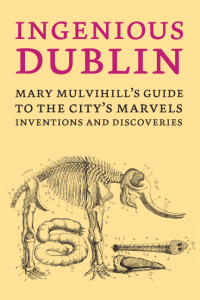
    “For instance, the skeleton of the elephant featured on the cover comes from an amazing dissection that was done in Temple Bar in 1681 and is world famous – an English theatre company is even talking about recreating the event in Essex Street next year!”

    The new guidebook is an e-book, making it easy to carry round the city on a smartphone or iPad.  It can be read on any device, thanks to free Kindle software and apps, and it comes with a complimentary e-book of 10 detailed maps.

    Ingenious Dublin is selling at a special launch price of just €0.99 (cover price €3.99) until September 15th.

    *Answers to questions: The Victorian diving bell is on Sir John Rogerson’s Quay. The Skeleton of Tommy can be found in the Zoology museum in Trinity College Dublin. The worlds first earthquake experiment was done on Killiney beach and Quarternion algebra invented in Cabra helped put a man on the moon.


  • A song, a walk and a good equation: podcast tour 1

    A song, a walk and a good equation: podcast tour 1

    Do you enjoy a song, a walk and a good algebra equation?

    William Rowan Hamilton quaternion walk
    Ireland's greatest scientist, Sir William Rowan Hamilton

    Then you’ll enjoy our podcast walking tour.  It features a lovely stroll by Dublin’s Royal Canal, tracing the steps of Ireland’s greatest scientist Sir William Rowan Hamilton, on the day he invented a new type of algebra.  Click to download the podcast here.

    Hamilton’s algebra is called Quaternions, and you could say that it helped to land a man on the Moon because, among other things, it’s used to control spacecraft, and was vital to Nasa’s Apollo missions.

    Every year, on Hamilton day (October 16th) hundreds of people join the annual commemoration walk from Dunsink Observatory to Broome Bridge, the very spot where Hamilton invented his new form of mathematics in a flash of inspiration.  It’s a key moment in the history of Irish science.

    Quaternion equation at Broome Bridge by the Royal Canal

    Our podcast was recorded on the 2011 walk, and features the ballad of William Rowan Hamilton (written by local man Jack Gannon), lots of stories and information about the Royal Canal, its engineering, wildlife, and even how canal locks work, plus interviews with many of the  people who attended.

    You can use the podcast to take your own tour along the canal towpath.  The audio lasts 44 minutes, and the route by the canal is about 4 km long, and wheelchair accessible.

    So if you fancy a stroll,  or even listening from the comfort of your couch, have a listen and learn about one of Ireland’s most important scientists.

    Click to download the podcast here.

    The podcast is presented by science journalist Mary Mulvihill, from Ingenious Ireland, and the production was supported by Maths Week Ireland and IRCSET.  Full details, the route, and getting to and from the canal are here.

    Promoting Ireland’s rich scientific heritage.

    This is the first in a series of Podcast tours — more to follow soon.

  • What inventions should be in our new tour?

    Ingenious Irish invention milk chocolate
    Our ingenious inventions tour will hopefully feature chocolate!

    From the stethoscope and the hypodermic syringe to Sudocrem… there are lots of ingenious inventions associated with Dublin and Ireland.  There are also some tasty ones — like milk chocolate and flavoured crisps — and rather a lot of boozy ones too (think: whiskey,  Bailey’s Irish cream, Irish coffee and draught Guinness in a can).

    At least some of these will feature in our new walking tour of ingenious inventions,  and we hope to have samples of some of these for you as well.

    But what other ingenious Irish inventions should we feature?  We’d love to hear your ideas.  And there is a wee prize for any we haven’t thought of yet.  Just add a comment below with your idea, or pop over to our Facebook page and tell us there.

    (It’s going to be quite a tour: the long list currently includes such ingenuity as Joly’s colour photography and radiation therapy; the humane hangman’s drop; Hamilton’s quaternions and board game; the word ‘Quiz’ (although its origins are disputed!), the ISBN, and even perforated stamps.  We hope to feature the wonderful Sugru too)


  • The ingenious Irish latch-hook needle

    The ingenious Irish luck chuck needleThe latch-hook needle, used by rug-makers the world over to knot yarn in carpets, was patented on this day, 1904.  The needle was invented by an ingenious Irish landlord, Robert Flower (1836-1919), the eighth Viscount Ashbrook of Durrow.

    His patented latch-hook needle had a hinged latchet that kept the yarn hooked so that, with one quick movement, the yarn was drawn through the canvas foundation and knotted.

    Flower’s needle simplified the process of making hand-tufted rugs and carpets, and gave rise to a small carpet factory in Abbeyleix that flourished for several years, making high-quality carpets for prestigious clients, including the Titanic.

    Robert Flower was an enthusiastic inventor, though one early experiment with gunpowder left him with a permanent limp!  He also patented designs for organ pipes, water-heating stoves and soldering aluminium, but his primary interest was textiles. He invented easy-to-use hand-looms designed for unskilled-workers and people with disabilities to earn an income,  and improved automatic looms.

    Deep-pile hand-tufted carpets have always attracted a premium price. They were traditionally made on large upright looms, and heavy beams supported the fabric rolls; each tuft was manually woven around the warp and knotted in place. Flower patented a new system for use with his needle, that was  simpler and faster than the traditional approach: his carpet was made on a small flat-bed loom that he designed; and the carpet’s canvas foundation was made on a separate automatic loom.

    A philanthropic entrepreneur from nearby Abbeyleix, Ivo de Vesci, was keen to provide local employment, and in 1904 he opened a carpet factory in Abbeyleix using Flower’s system. Similar ventures were being established around the country to create work for local women in a bid to slow emigration and save rural communities.

    The Abbeyleix factory commissioned designs from well known artists, and earned an international reputation and numerous awards. At its peak 24 women worked there, and a team could produce a carpet 12-feet by 15-feet in three months, with yarn tied at 20 knots to the square inch. Their carpets graced Ascot’s grandstand and Dublin’s Mansion House, and were sold in Harrods of London and Marshall Fields of Chicago.

    The venture was not a commercial success, however, and in 1909 it merged with Naas carpet factory (begun by the Mercy Sisters in 1902), to form Kildare Carpets. The Abbeyleix site was extended and production changed from Flower’s workbenches to large upright beam looms. The Abbeyleix workers now supplied the company’s most notable order – carpets for rms Olympic and Titanic, orders won through de Vesci’s friend and White Star Line chairman, Lord Perrie.

    But the merger with Naas had never been happy, and industrial problems in England disrupted the crucial yarn supplies. In December 1912 the Abbeyleix factory closed, and Naas followed a few years later. Robert Flower’s innovative needle, however, is still used the world over.

    http://www.heritagehousemuseum.com/
    Visit: Abbeyleix heritage museum, and see the recreated carpet factory with looms, latch-hook needles and original carpets, and an exhibition about the Titanic connection.

Privacy Overview
Ingenious Ireland

This website uses cookies so that we can provide you with the best user experience possible. Cookie information is stored in your browser and performs functions such as recognising you when you return to our website and helping our team to understand which sections of the website you find most interesting and useful.

Strictly Necessary Cookies

We use these cookies to make our website work including:

- Making our shopping basket and checkout work
- Determining if you are logged in or not
- Allowing you to add comments to our site

If you really want to turn off these cookies you can usually switch cookies off by adjusting your browser settings - find out how here. Please note: the website might not function as well without these cookies.